2026
News list
-
AI-powered semantic mapping of the whole vocal repertoire in a cooperative bird society
Prof. Dr. Vittorio Baglione, Department of Biodiversity and Environmental Management, University of León
17.03.2026 10:00-11:30
Y42-K-80
-
Responses of mountain gorillas (Gorilla beringei beringei) to deceased infants
Drawing on 21 years of data from 141 infant deaths, this study shows that mountain gorilla mothers frequently carry deceased infants, with patterns shaped by infant age and cause of death. Findings highlight attachment bonds, caregiving roles and primate responses to death.
-
Not All Stress Is the Same: Variable Associations Between Psychosocial Stressors and Urinary Cortisol Rhythms in a Small-Scale Subsistence Society
Among Tsimane adults in Bolivia, different stressors—food insecurity, social conflict and economic problems—were linked to distinct daily cortisol patterns. Results reveal complex associations between stress, health and HPA-axis function in a subsistence society.
-
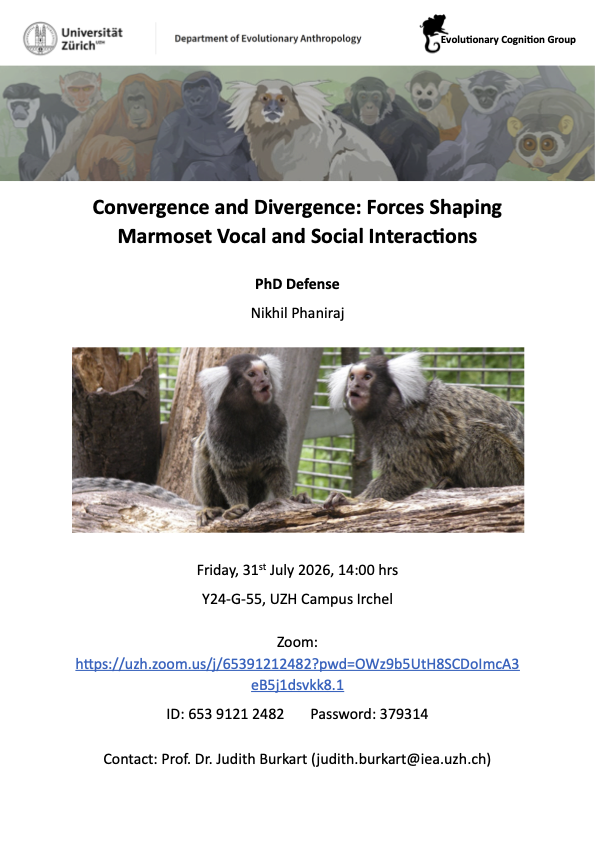
PhD Defense Nikhil Phaniraj
Convergence and Divergence: Forces Shaping Marmoset Vocal and Social Interactions
-
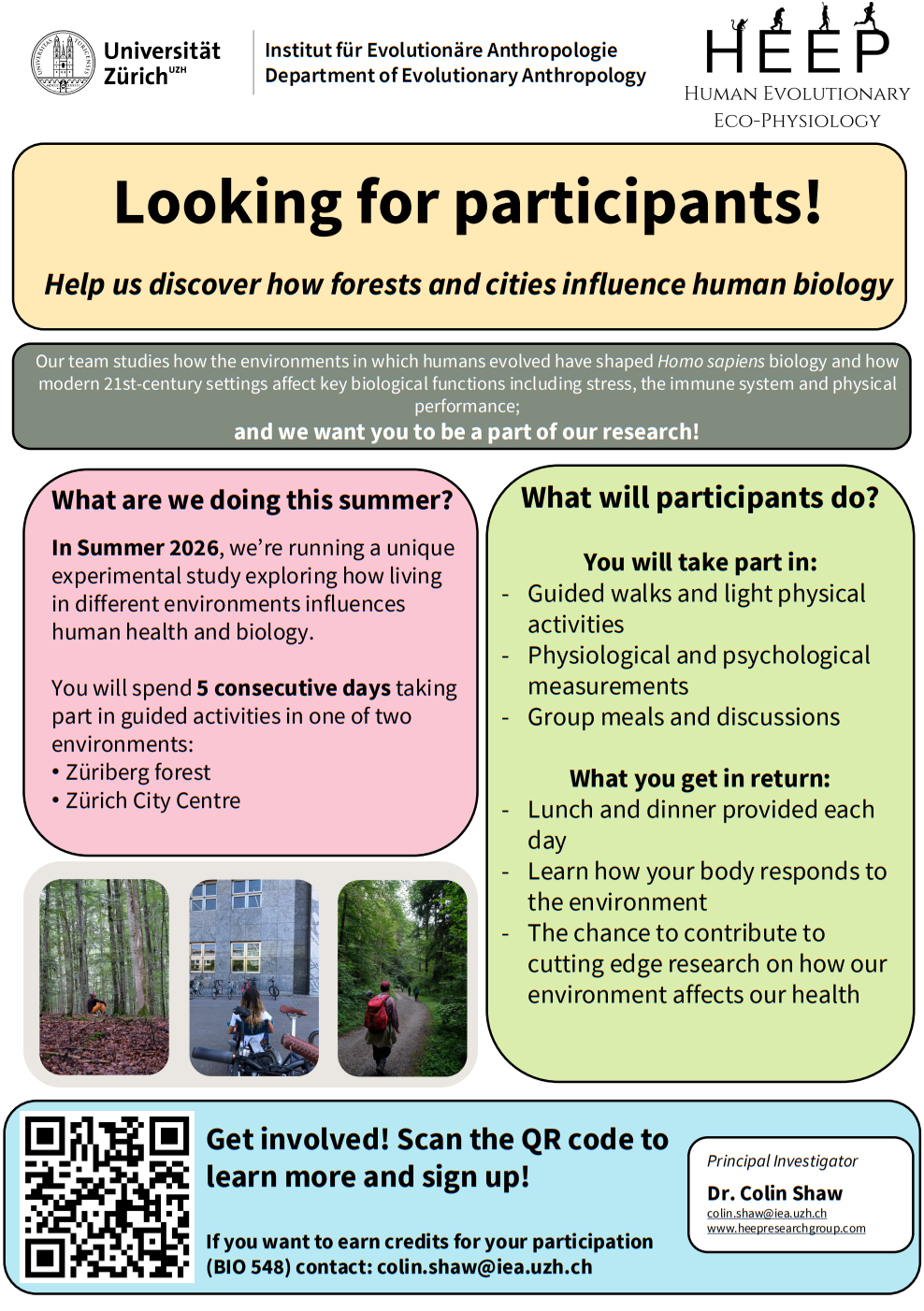
Looking for participants
Help us discover how forests and cities influence human biology
-
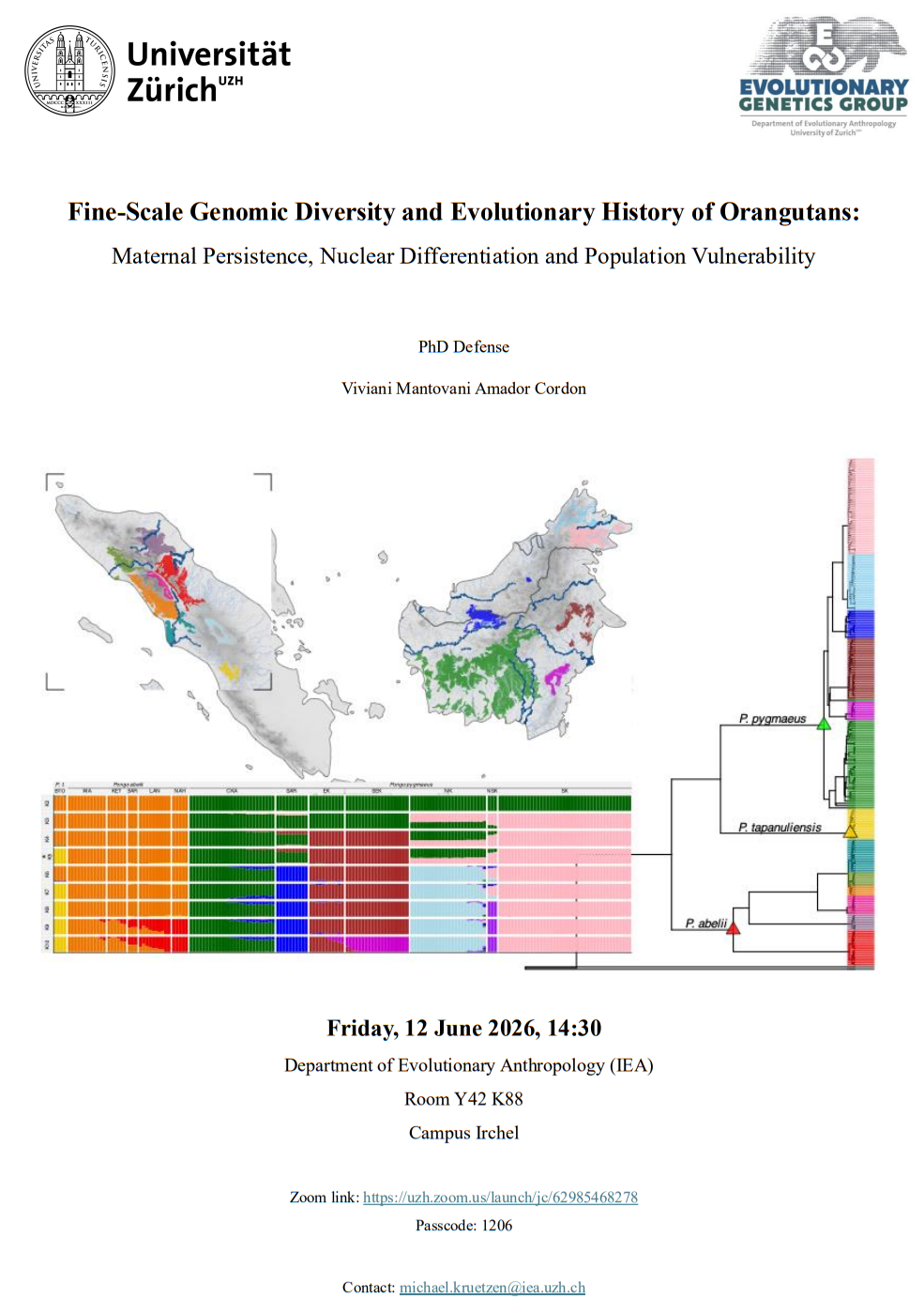
PhD Defense Viviani Mantovani Amador Cordon
Fine-Scale Genomic Diversity and Evolutionary History of Orangutans:
Maternal Persistence, Nuclear Differentiation and Population Vulnerability -
-

PhD Defence Svenja Marfurt
From Shallow Markers to Deep Genomes: Seascape Genomics of Indo-Pacific Bottlenose Dolphins (Tursiops aduncus) across Past, Present, and Future Oceans
-
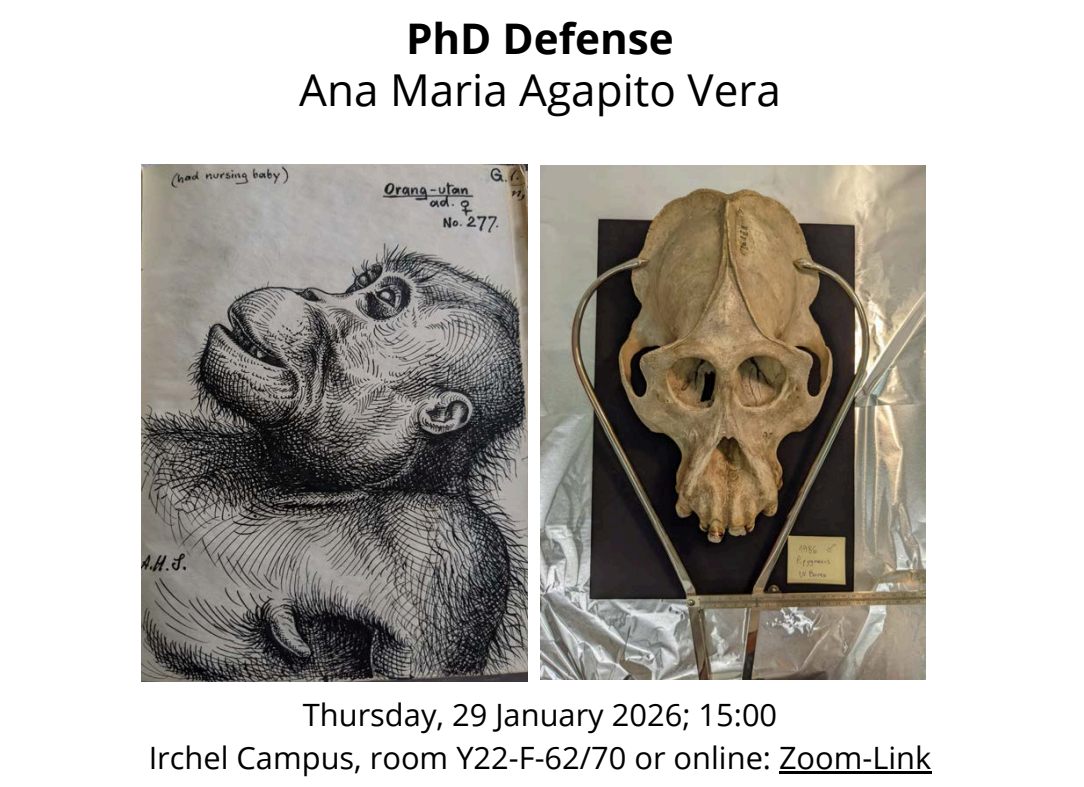
PhD Defense Ana Maria Agapito Vera
Population Genomics of Orangutans (genus: Pongo) Using Historical Specimens from Museums and Collections
-
UZH-Wide Media Success
The University of Zurich’s Top 10 Most-Read Research Stories of 2025 are out — and two of them come straight from our department!
#6 – Bonobo Call Combinations
#8 – Into the Woods with Colin Shaw
-
Culture is critical in driving orangutan diet development past individual potentials
Agent-based modelling of wild orangutan behaviour shows that social learning is essential for developing adult-like diet repertoires on time. Findings indicate that orangutan diets are culturally dependent and exceed individual learning limits.
-
Great Ape Childhoods: Social and Spatial Pathways to Independence in Bonobo and Chimpanzee Infants
Comparing wild bonobo and chimpanzee infants, this study finds similar developmental trajectories but distinct social and spatial patterns. Results show how species-specific social systems shape early independence and development in great apes.
-
Oxytocin varies across the life course in a sex-specific way in a human subsistence population
Using the largest oxytocin dataset to date from the Tsimane of Bolivia, this study shows sex-specific, nonlinear changes across the life course, linking oxytocin to reproduction, caregiving and health under conditions of energetic constraint.
-
Higher-order interactions shape collective human behaviour
This paper shows how higher-order social network models capture group interactions beyond pairwise ties. Using empirical data, it reveals mechanisms of cooperation, contagion and moral behaviour invisible in traditional dyadic network approaches.